
Someone recently asked me, “Why support women?” My simplest, most honest answer (being a woman and all) is my bias towards women. But the answer for Nature’s Pitch does not stem from personal preference. Supporting women is part of how we understand the work we do and the kind of change we want to contribute to.
Long before conversations about gender equality, women were growing food, caring for families, building businesses, passing knowledge from one generation to the next, contributing to science and technology, organising communities and finding ways to keep households and economies going. Much of this work, however, has gone unrecognised for its value in keeping societies functioning.
Today, we have more language, data and awareness around the barriers women face.
We also have a much longer history of women challenging those barriers.
The History
The global movement for women’s rights has been building for generations. And, eventually, governments started formalising these conversations. In 1946, the United Nations established the Commission on the Status of Women, bringing questions around women’s rights and equality onto the international agenda. Over the following decades, international agreements and women’s movements continued to push issues such as education, economic participation, political representation and protection from discrimination onto the global agenda.
But perhaps one of the most significant moments came almost 50 years later.
In 1995, thousands of people gathered in Beijing for the Fourth World Conference on Women. Representatives from 189 governments adopted the Beijing Declaration and Platform for Action, committing to action across areas including education, poverty, economic participation, decision-making, human rights and the environment. This was a defining moment because the conversation was no longer simply about recognising that women mattered. It was about changing the systems that determined what women could access, influence and achieve.
Thirty years later, we can see the progress. More girls are in school. More women are entrepreneurs, scientists, academics, professionals and leaders. Despite this progress, the barriers still remain. UN Women’s 2025 review found that gender discrimination remains deeply embedded in economies and societies around the world.
Food and Agriculture
According to a 2026 FAO report, 76% of working women in sub-Saharan Africa are employed in agrifood systems, the largest share of any region globally. Women are involved across food production and other parts of agrifood systems, while also carrying substantial unpaid care and household responsibilities that contribute to food and nutrition security.
However, being involved does not necessarily mean having equal access to resources.
Women are less likely than men to own agricultural land in most countries. In nearly 90% of the countries for which data are available, fewer than half of women have secure rights to agricultural land. Land ownership matters because it can influence a person’s ability to invest, access finance and build a sustainable livelihood.
The same pattern appears in science and technology.
Women make up only 35% of STEM graduates globally, a figure that UNESCO says has remained unchanged for a decade. Across Africa, women account for around 30% of science professionals, while barriers such as limited resources, social expectations, lack of role models and unequal access to opportunities continue to affect participation.
So the question is not whether women are capable of contributing, rather what happens when we remove some of the barriers standing between women and the resources they need to do more.
Support Beyond Funding
Funding is one part of the equation. Access to networks is another. So are technical knowledge, mentorship, visibility, equipment, markets and the confidence that comes from knowing that someone is willing to back your idea.
These things can determine whether an idea stays small or has the opportunity to grow, which is particularly important when we talk about nature-based solutions.
The environmental challenges facing communities are rarely isolated from their economic and social realities. A degraded ecosystem can affect food, income and livelihoods. Poor waste management can affect health and the environment. Limited access to clean energy can affect households and businesses.
Women are already part of these systems. They are farmers, entrepreneurs, researchers, community organisers, educators, innovators and leaders. And we want to support them in those roles.
What this looks like at Nature’s Pitch
For us, supporting women amounts to more than just putting a woman’s name on a programme and calling it inclusion. We look at where resources can make a meaningful difference and intentionally create space for women to access them. That is why women are an important part of the work we support at Nature’s Pitch.
Take the Bodo Mangrove Project by RACOFA and UMITA, where community-led mangrove restoration is being carried out across several coastal villages in Kenya. At the center of the project is a community whose livelihoods are closely tied to the land and sea, including fishers and farmers, and women are central to the project’s leadership. They are contributing to the health and resilience of the coastal ecosystem, while facing significant challenges. Limited access to equipment, technical training, transportation and income-generating opportunities can make restoration work much harder. Yet the community has already restored an estimated 260 hectares of a targeted 525 hectares.
Then there are women working in spaces where innovative solutions are emerging in response to very specific challenges.
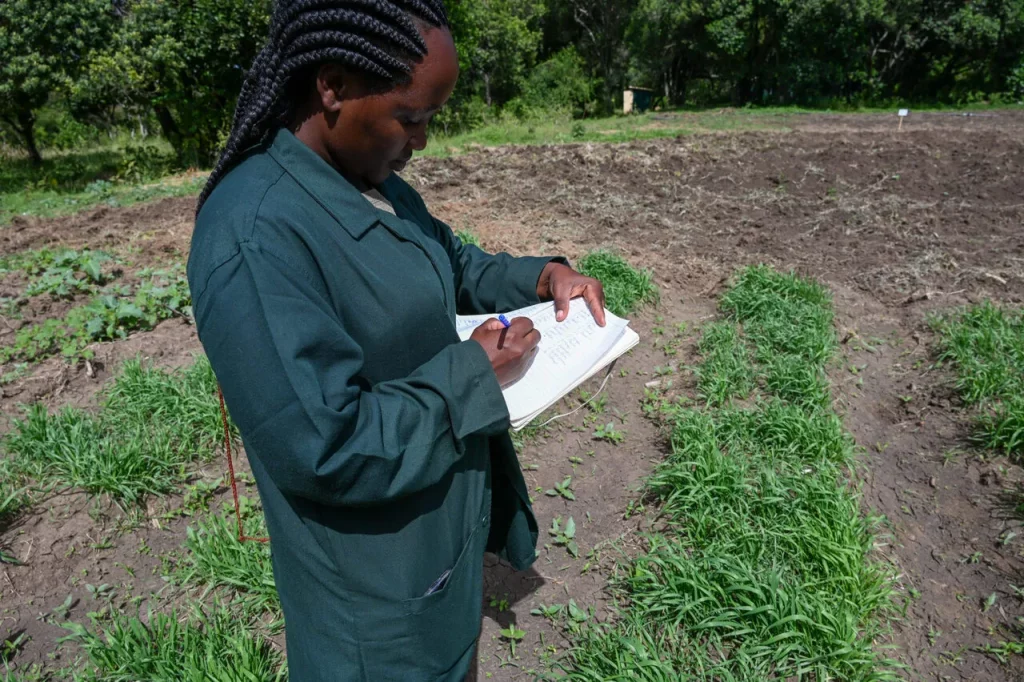
Rather than simply accepting human-elephant conflict as an unavoidable part of life around wildlife areas, Abigael Pertet of the Mara Experimental Farm has been experimenting with crops that elephants are less likely to eat. It is a practical idea rooted in observation and experimentation. The goal is to find ways for people to continue farming while reducing conflict with elephants.
This is a representation of what supporting women in STEMM means to us. Understanding that innovation can happen on a farm as opposed to a laboratory or behind a desk, and that some of the most practical solutions can come from people who are simply paying attention to the problems around them and experimenting with new ways to solve them.
And our wider grantee portfolio reinforces this.
Why this matters
Simply put, supporting women is not separate from supporting communities, economies or the environment.
When a woman gains access to funding, that can help her develop an enterprise. Access to technical support enables an idea to become a viable solution. Visibility creates an opportunity for new partners and markets. Holding positions in leadership opens up a new world for other women and girls where they can see themselves in those roles. And when women are able to participate fully in economic and environmental decision-making, the benefits can extend to the greater community.
There is strong evidence for this. FAO reports that closing gender gaps in agricultural productivity and wages could increase global GDP by nearly $1 trillion and reduce the number of food-insecure people by 45 million.
As nice as this sounds, it does not mean that every woman will create a transformative business or solve a major environmental challenge. This is a statement that opportunity matters, and that we cannot know what ideas we are missing when people do not have a fair chance to develop them.
With all that said, it does not mean that women are helpless and always waiting for someone to rescue them. They are already solving problems, conducting research, building businesses, improving livelihoods and protecting the places they call home.
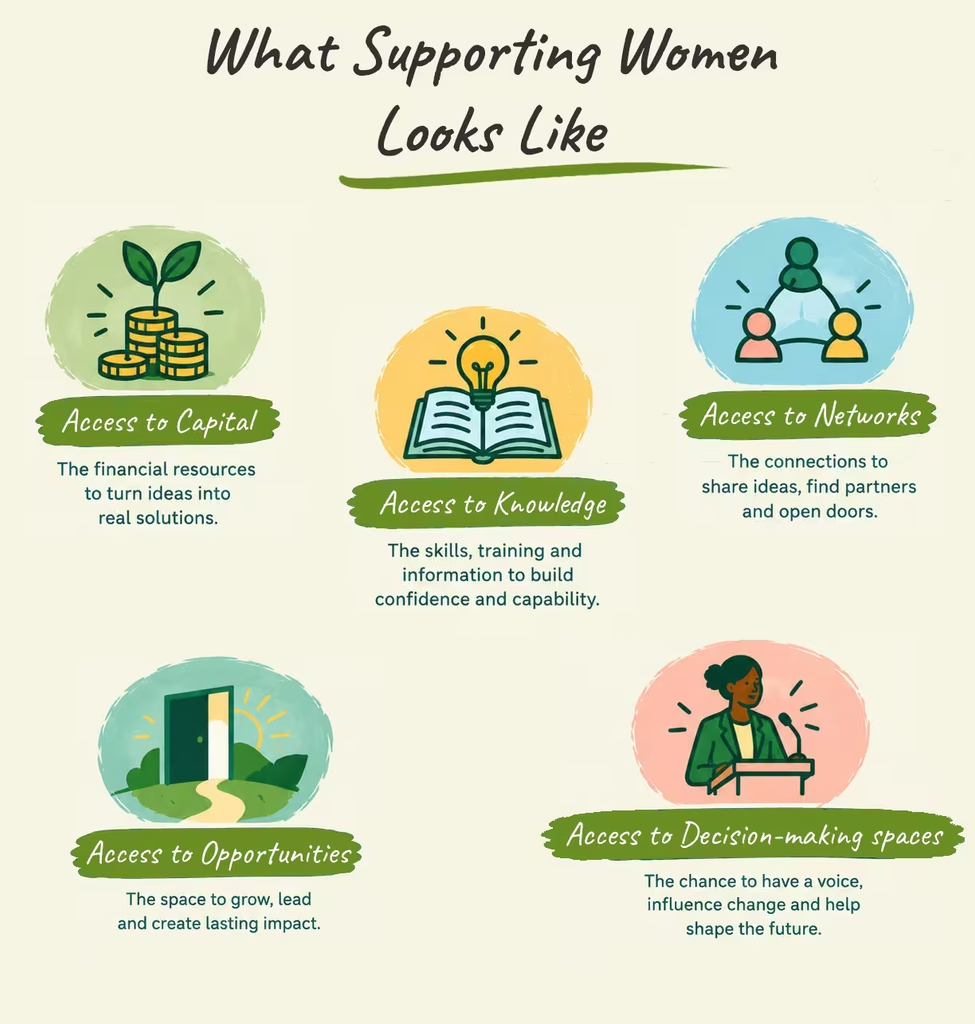
Supporting women comes down to access:
- Access to capital.
- Access to knowledge.
- Access to networks.
- Access to decision-making spaces.
- Access to opportunities.
That is what supporting women looks like for us.